Why Your Bank's Mutual Funds Could Be Costing You Nearly $1 Million in Retirement
Why Your Bank's Mutual Funds Could Be Costing You Nearly $1 Million in Retirement
The $993,400 Question Nobody Is Asking You
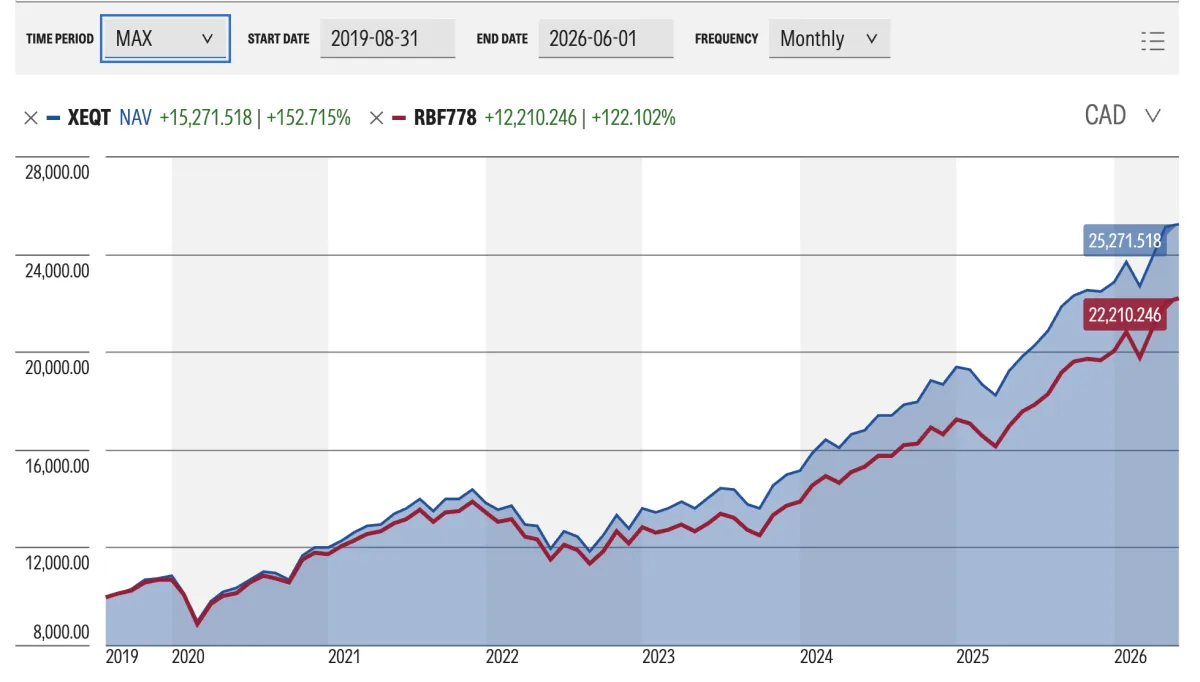
Let's run the numbers. Same starting amount. Same time horizon. Same aggressive growth strategy. Just two different investment vehicles.
Scenario: $50,000 invested at age 30, over 30 years.
Path 1: RBC Select Aggressive Growth Portfolio
MER (Management Expense Ratio): 2.20%
10-year net return: 9.08%
Value after 30 years:$679,700
Path 2: XEQT (All-Equity ETF)
MER: 0.20%
10-year net return: 13.30%
Value after 30 years:$1,673,100
The difference: $993,400.
Same money in. Nearly a million dollars different out. WTF.
It's Not That You Made Bad Choices. Nobody Told You There Was a Better One.
This is the part that makes so many Canadians angry when they finally see it.
You did not end up with $679,000 instead of $1.6 million because you were irresponsible with money. You ended up there because a bank representative sat across from you, put a fund in front of you, and never once explained what a 2% MER actually means over time.
A 2% fee sounds like almost nothing. It sounds like the cost of a coffee.
But on your first $50,000 alone, over 30 years? That 2% is costing you close to a million dollars. That is what "two percent" actually means in real life.
The fees are not hidden. They are just never explained.
Why the Banks Are Getting Rich While You're Falling Behind
Canada's big banks are reporting profits in the billions, and a meaningful portion of that money is coming directly from the MERs charged on products like the RBC Select Aggressive Growth Portfolio.
It is not just RBC. TD, Scotiabank, BMO, CIBC. They are all running the same playbook. High-fee mutual funds sold through in-branch advisors who are, in many cases, incentivized to recommend their own institution's products.
Meanwhile, everyday Canadians are dealing with a wobbling loonie, rising energy prices, and the general squeeze of a cost-of-living crisis. This is exactly the wrong time to be quietly donating hundreds of thousands of dollars to Bay Street.
The math is not complicated. The system just counts on you not running it.
XEQT vs. Bank Mutual Funds: What's Actually Different?
You might be wondering.... if the outcomes are so dramatically different, why is not everyone invested in ETFs like XEQT?
Great question.
XEQT(iShares Core Equity ETF Portfolio) is an all-equity, globally diversified exchange-traded fund. It holds thousands of stocks from around the world and has a management fee of just 0.20%, a fraction of what most bank mutual funds charge.
The underlying asset allocation between a fund like the RBC Select Aggressive Growth Portfolio and XEQT is actually quite similar. Both lean heavily into global equities for long-term growth. The difference is not the strategy. It is the cost.
Every percentage point of fees is a percentage point that is not compounding in your favour over 30 years. And compound interest is one of the most powerful forces in personal finance. High fees quietly destroy it.
This is why I've personally been investing in low-fee index ETFs since I started DIY'ing.
Two Paths Forward: How to Stop the Bleed
If you have money sitting inside a high-fee bank mutual fund right now, you have options. You do not need to be wealthy or financially sophisticated to access better investments. You just need to know where to look.
Option 1: Go the DIY Route with Wealthsimple
Wealthsimple Trade makes it genuinely simple to open a self-directed account and buy an all-in-one ETF portfolio (like XEQT) that matches your time trajectory and risk tolerance. There is no commission on ETF purchases, and you are in full control.
This is a great fit if you are comfortable doing a bit of reading and want to keep things simple. XEQT is ONE option of the all-in-one-ETF portfolio. You buy it, you leave it alone, you let it grow. Just make sure you're picking the right all-in-one-ETF portfolio. This is IMPORTANT!
Option 2: Use a Robo-Advisor with Justwealth
Not a DIYer? No problemo.
You do not have to manage your own portfolio to escape high-fee funds.
Justwealth is my favourite Canadian robo-advisor that builds and manages a low-cost, diversified portfolio for you, automatically. You answer a few questions about your goals and risk tolerance, and they handle the rest. The fees are a fraction of what the banks charge.
It's super easy to set up an account and transfer your funds from your relinquishing institution!
The First Step Is the Most Important One
Whether you go DIY or robo-advisor, the most important move is simply getting your money out of high-fee products and into something that works harder for you (like those all-in-one ETF portfolios).
You worked hard for that money. It should be working just as hard in return.
Check your investments today. Look up your MER. If it is sitting above 1.5%, it's worth asking whether you are getting value for that cost, or simply paying for someone else's quarterly earnings report.
You deserve to keep what you earn.
Ready to Take Back Control of Your Money?
If you want to go deeper on this and get a clear plan for your own investments, the Broad Money Collective is the place to start.
Join us here:


